ISO 9001:2026 updates
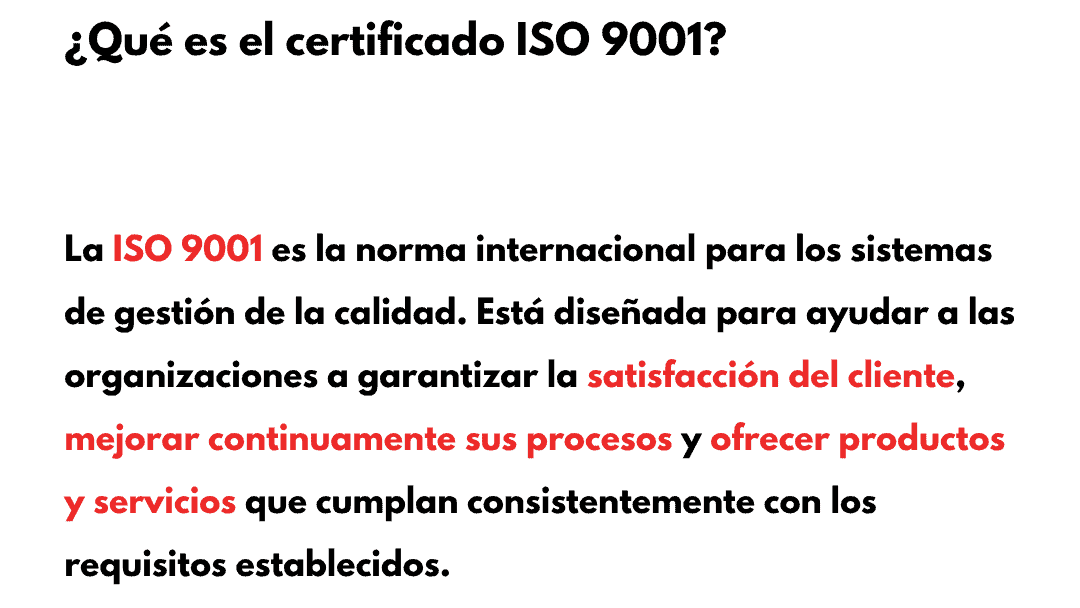
What is ISO 9001 certification?
The ISO 9001 certificate for quality management systems demonstrates conformity with the requirements of the international standard ISO 9001. It is designed to help organisations ensure customer satisfaction, continually improve their processes and provide products and services that consistently meet established requirements.
Key changes to ISO 9001
Terms and definitions: Clause 3
Clause 3 brings together the official definitions used in the standard and establishes that key concepts are interpreted in accordance with the normative documents in the ISO 9000 series. Its aim is to ensure that all organisations apply the quality management system using the same meaning for each term. Our services have helped many clients become success stories by achieving ISO 9001 certification.
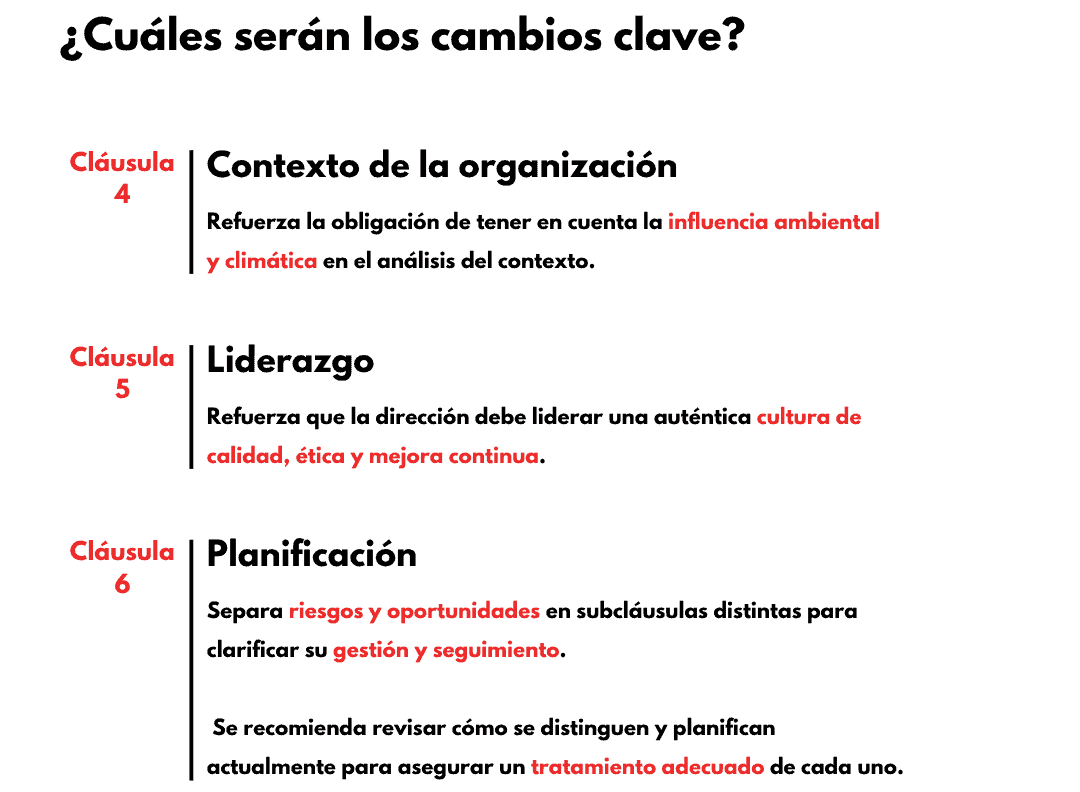
Context of the organisation: Clause 4
The new version of the requirements for the context of the organisation reinforces the need to analyse how environmental factors and climate factors affect the company’s processes. This means reviewing the context analysis to include risks and constraints arising from the natural environment, sustainability and changes in environmental regulations.
Leadership and commitment: Clause 5
Top management will need to demonstrate active leadership based on a culture of quality, ethics and continual improvement. Approving documents is not enough: leadership must be visible, consistent and focused on ensuring that the system functions as a natural part of the organisation’s day-to-day activities.
Planning: Clause 6
Risks and opportunities are separated into distinct subclauses to clarify their management. The company must review how it currently identifies, assesses and plans for them, ensuring that risk management is not confused with the management of opportunities. This will enable clearer, more clearly defined monitoring.
Support: Clause 7
This ensures that the organisation has everything it needs to operate its quality management system effectively: competent people, a suitable environment, valid information, effective communication and controlled documentation. Without this support, the other processes cannot function properly.
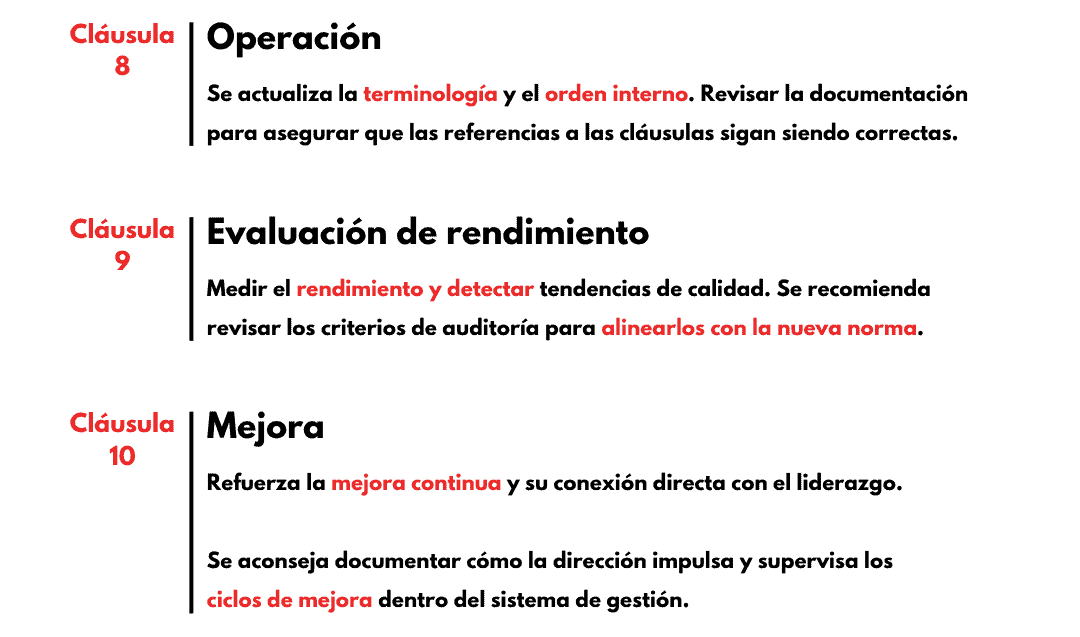
Operation: Clause 8
The internal structure of the clause and some of its terminology are being updated. The substance remains the same, but the organisation changes. Procedures, instructions and internal documents will need to be checked to ensure that they still refer to the correct clauses and do not use outdated numbering. As an ISO consultancy, we will help you ensure that everything is in order.
Performance evaluation: Clause 9
The new version reinforces the need to measure performance and identify quality trends. This means reviewing indicators, management reviews and ISO audit criteria to ensure that they align with the standard’s new approach.
Improvement: Clause 10
Continual improvement is directly linked to leadership. The company will need to demonstrate how top management drives improvement, oversees the resulting plans and evaluates their effectiveness. It is advisable to clearly document improvement cycles and top management’s active role in them.
Clauses that remain unchanged
Scope: Clause 1
- Clause 1 of ISO 9000 defines the scope of the standard and the key quality management principles applicable to any organisation. It also provides a common framework for ensuring confidence in products and services while improving communication through a shared vocabulary. Finally, it strengthens the supply chain and supports audits, assessments and training related to ISO 9001.
Fundamental concepts and principles: Clause 2
- Clause 2 of ISO 9000 explains the essential concepts and quality management principles that underpin all ISO 9001 standards. Specifically, it defines how processes work, customer focus, leadership, continual improvement and evidence-based decision-making. Its aim is to ensure a common understanding that facilitates effective implementation, audits and quality systems.
Which other standards will change?
ISO 14001 – Environmental management (new version expected in 2026–2027)
The next edition of ISO 14001 will place greater emphasis on climate change, life cycle management, ESG goals and environmental compliance. The revision aims to align the standard with global trends in sustainability, the circular economy and measurable environmental performance. It will require updates to risk analysis, environmental aspects and operational controls.
ISO 45001 – Occupational health and safety (revision underway)
The update to ISO 45001 will include improvements in risk management, prevention culture, worker participation and contractor control. There will be greater emphasis on workplace wellbeing, psychosocial factors and safety leadership. Companies will need to review procedures, risk assessment and internal participation.
ISO 14064 – Carbon footprint (greenhouse gases)
The next edition will update quantification methodologies, the life cycle approach, calculations of scope 1–2–3 emissions and verification requirements. It will be more closely aligned with international standards (GHG Protocol and SBTi). Companies will need to adjust inventories, organisational boundaries and supporting data evidence to ensure consistency with GHG reports.
ISO 50001 – Energy management (revision planned)
The next version of ISO 50001 will strengthen advanced energy measurement, data digitisation, integration with ISO 14001 and criteria for demonstrating improvements in energy performance. There will be changes to the energy review, baseline, EnPI indicators and technical documentation. This will affect energy-intensive sectors.
ISO 22301 – Business continuity (revision scheduled)
The revision of ISO 22301 will place greater emphasis on organisational resilience, cyber incidents, digital recovery and the management of critical suppliers. Changes are expected to the BIA, risk analysis, RTO/RPO times and continuity strategy. Plans, matrices and exercises will need to be updated, especially in technology sectors.
ISO/IEC 27001 – Information security (adjustment planned)
ISO 27001 certification will undergo a minor update to align with changes to ISO 27002: new controls, improved implementation guidance and adjustments to documentation and risk assessment requirements. This will not be a full revision, but it will be a significant change for audits.
ISO 37001 – Anti-bribery systems (revision underway)
ISO 37001 certification will receive an update that strengthens due diligence, supplier integrity controls and documentary evidence. It will align with global compliance trends, including criminal law compliance and anti-corruption. Organisations will need to improve risk assessments and internal policies.
ISO 20000 – IT service management (revision underway)
ISO 20000 certification is being modernised to adapt to cloud environments, managed services, automation and DevOps models. It will include new requirements for SLAs, incidents, agile changes and technical competence. This will directly affect IT companies and technical support.